
A prolactinoma is a benign tumor of the pituitary gland (hypophysis) that produces too much of the hormone prolactin. Symptoms may result from the excess hormone or from the tumor pressing on surrounding tissue. Prolactinomas are usually treated with medication. For some patients, surgery may also be an option. It can lead to a permanent cure. At the Pituitary Center at Inselspital, Bern University Hospital, we provide interdisciplinary counseling on all treatment options.
Prolactinoma – key facts at a glance
- Benign. A prolactinoma is a benign tumor of the pituitary gland and is not cancer.
- Symptoms. Typical signs include menstrual irregularities, milk secretion from the breasts outside of breastfeeding, loss of libido, erectile dysfunction, and difficulty conceiving. Large prolactinomas can cause headaches and visual disturbances.
- Diagnosis. Prolactin levels are measured in the blood. Magnetic resonance imaging (MRI) visualizes the pituitary gland.
- Medications. Cabergoline lowers prolactin levels to normal in most patients. Treatment often lasts several years.
- Surgery. In many cases, a permanent cure is possible for small, well-defined prolactinomas. The surgery is performed using an endoscope through the nose.
How common is a prolactinoma and who is affected?
Prolactinomas account for about half of all pituitary adenomas *, *. Depending on the study, 25 to 63 out of every 100,000 people have a prolactinoma. Each year, 2 to 8 out of every 100,000 people are newly diagnosed with the condition *.
Between the ages of 20 and 50, women are affected about ten times more often than men. After age 50, women and men are affected with roughly equal frequency *.
In women, small tumors (microprolactinomas, smaller than 1 cm) are usually detected, while in men, larger tumors (macroprolactinomas, 1 cm or larger) are more common. One possible reason for this is that menstrual irregularities in women are noticed early on, whereas symptoms in men often go unnoticed for longer. In men, prolactinomas also more frequently invade surrounding tissue and, on average, respond slightly less well to medication *, *.
Is a prolactinoma dangerous?
A prolactinoma is a benign tumor and does not metastasize. However, without treatment, elevated prolactin levels can impair fertility and lead to a loss of bone density. Metabolic changes are also possible, such as weight gain or insulin resistance. With insulin resistance, the body’s cells respond less effectively to insulin. Large prolactinomas can damage the optic nerves *.
About 2% of prolactinomas grow rapidly and are therefore considered aggressive. This occurs more frequently in young men *.
What symptoms does a prolactinoma cause?
After childbirth, the hormone prolactin stimulates milk production. At the same time, high prolactin levels suppress the production of sex hormones. This can impair sexual function and fertility *, *.
- In women, menstrual periods may become irregular or stop altogether. Milk may leak from the breasts even outside of pregnancy and breastfeeding (galactorrhea). Other possible symptoms include vaginal dryness, acne, and increased body hair.
- In men, loss of libido and erectile dysfunction are typical symptoms. Less commonly, breast enlargement, anemia, fatigue, or a loss of muscle mass may occur.
- In both women and men, difficulty conceiving, weight gain, and mood swings are possible. Bone density may also decrease, increasing the risk of vertebral fractures. Headaches, depending on prolactin levels, are also common.
Larger prolactinomas can press on the optic nervesor cause the pituitary gland to produce insufficient amounts of other hormones. About one-quarter of people with a macroprolactinoma (1 cm or larger) experience visual field defects *.
Headaches are also common. In one study, just under 30% of patients had headaches at the time of diagnosis. In the long-term follow-up after treatment, this figure had dropped to 3% *.
Fatigue and difficulty concentrating may also occur. In a Dutch survey of 450 women with a prolactinoma, nearly 90% reported fatigue. Anxiety, depressive mood, and disease burden were more pronounced when prolactin levels were still elevated than when the condition was well controlled *.
How is a prolactinoma diagnosed?
The diagnosis is based on two main factors: measuring prolactin levels in the blood and performing a magnetic resonance imaging (MRI) scan of the pituitary gland *.
Elevated prolactin levels – could a prolactinoma be the cause?
Elevated prolactin levels can have various causes. Since stress can temporarily cause a significant increase in prolactin levels, blood should be drawn on an empty stomach and while the patient is at rest *, *.
Pregnancy and breastfeeding, hypothyroidism, kidney disease, and certain medications can also raise prolactin levels. These include some medications used to treat mental health conditions (antipsychotics) and anti-nausea medications. If the prolactin level is more than ten times the upper limit of the normal range, this is more likely indicative of a prolactinoma. Such high levels are typically not caused solely by medication *.
In about 20% of people with elevated prolactin levels, so-called macroprolactin is found. This form of prolactin has little effect in the body and can be distinguished from the active form in the laboratory *.
Prolactinoma or pressure on the pituitary stalk?
The pituitary stalk connects the pituitary gland to the brain. If a non-functioning pituitary adenoma presses on the stalk, less dopamine reaches the pituitary gland. This neurotransmitter normally inhibits the production of prolactin. If its effect diminishes, the prolactin level rises. It is usually below 200 ng/ml *.
A prolactinoma produces prolactin itself. The larger the tumor, the higher the prolactin level tends to be *. Comparing prolactin levels and tumor size helps distinguish between the two tumor types *, *, *. This is important for choosing the right treatment, because the medications used to treat a prolactinoma are ineffective against a non-functioning adenoma.
In the case of very large prolactinomas, an extremely high prolactin level can interfere with the laboratory test. Under these circumstances, the test may show only a slightly elevated level. If this so-called Hook effect is suspected, the laboratory dilutes the blood sample and measures it again *, *.
Magnetic resonance imaging and other tests
The MRI shows how large the tumor is, where it is located, and how close it is to the optic nerves, the carotid artery, and the cavernous sinus. The cavernous sinus is a venous cavity adjacent to the pituitary gland. An irregular appearance in certain MRI images (T2-weighted images) may indicate—especially in men—that the tumor is less responsive to medication *, *. If a small tumor cannot be clearly identified on the MRI, a specialized PET scan may provide further insight *.
Additional blood tests are used to determine whether the pituitary gland is producing sufficient amounts of other hormones. For larger tumors, the visual field is also measured *. If surgery is planned, an additional computed tomography (CT) scan can aid in surgical planning. For more information, see Pituitary adenoma – Diagnosis.
Microprolactinomas and macroprolactinomas – what is the difference?
The main difference lies in size: A microprolactinoma measures less than 1 cm, while a macroprolactinoma measures 1 cm or more. However, there are also differences in behavior: Microprolactinomas rarely grow. In an observational study, half of the 26 microprolactinomas shrank without treatment. Only one grew *. Macroprolactinomas, on the other hand, can grow more aggressively, especially in men. They are therefore monitored at shorter intervals *.
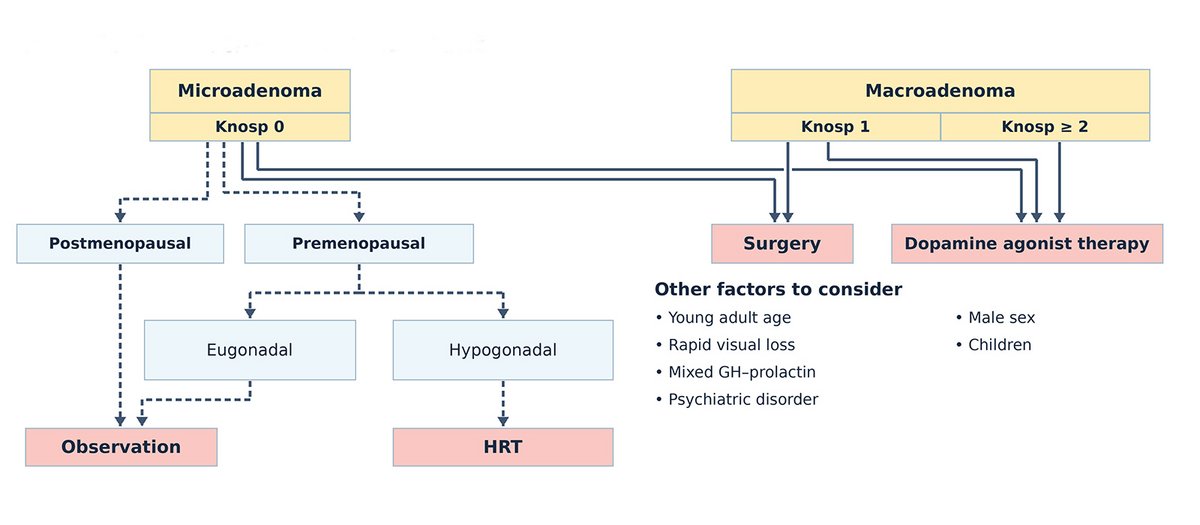
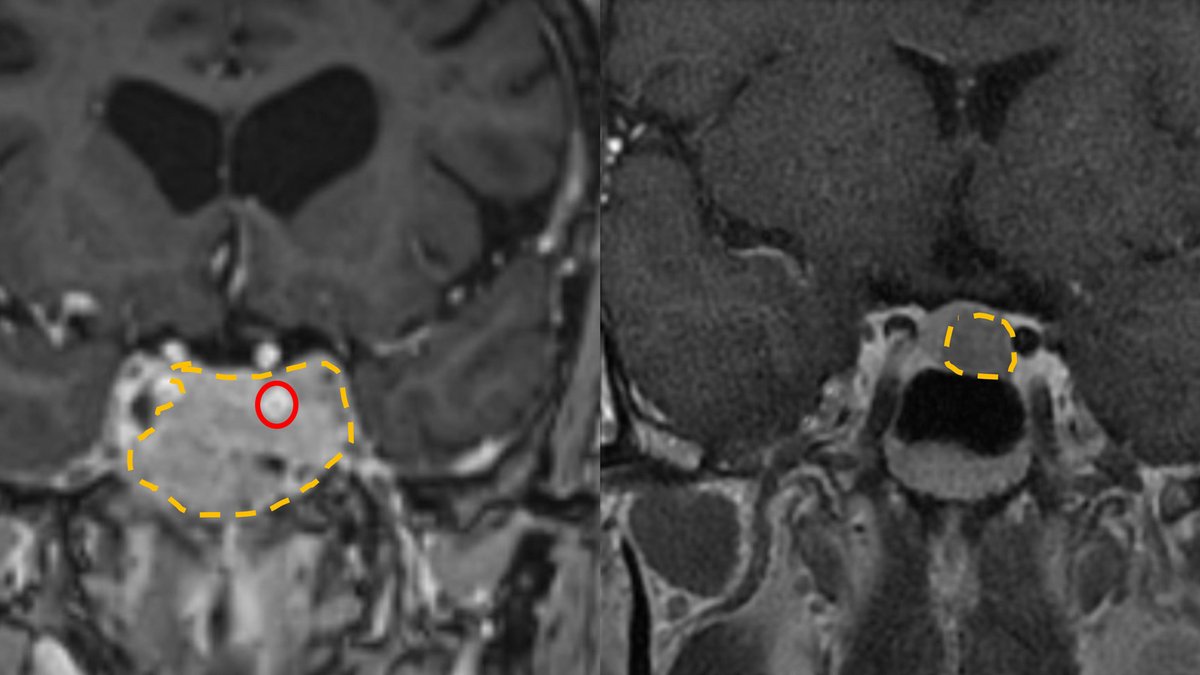
Another crucial factor in choosing a treatment is how far the tumor extends toward the cavernous sinus. This is a venous space adjacent to the pituitary gland through which the carotid artery passes. The treatment team assesses the extent of the tumor based on MRI images using the so-called Knosp classification. At grades 0 and 1, the tumor is well-defined; from grade 2 onward, it increasingly invades surrounding tissue and, at its greatest extent, can encase the carotid artery (grade 4) *.
How is a prolactinoma treated?
The goal of treatment is to normalize prolactin levels, relieve symptoms, and shrink or remove the tumor. Treatment usually begins with medications.
For small prolactinomas (microprolactinomas) and well-defined larger prolactinomas (macroprolactinomas with a Knosp grade of 0 or 1), the International Pituitary Society recommends discussing surgery as an equally valid option even before treatment begins. A prerequisite is that the procedure be performed by a specialist with experience in pituitary surgery *, *.
The most appropriate treatment depends on the size and location of the tumor, the prolactin level, any desire to have children, and the patient’s personal preferences *, *.
In the case of a microprolactinoma without bothersome symptoms—for example, after menopause—the condition may be monitored only or treated with hormone replacement therapy (e.g., the birth control pill) *, *.
Traitement médicamenteux
La dopamine, un neurotransmetteur, freine la production de prolactine. Les médicaments qui agissent de manière similaire à la dopamine (les agonistes de la dopamine) réduisent le taux de prolactine et peuvent faire régresser la tumeur. On utilise le plus souvent la cabergoline (disponible en Suisse sous le nom de Dostinex®, par exemple). Comme son effet est prolongé, elle n’est prise qu’une à deux fois par semaine. Le traitement commence par une faible dose, qui est ajustée progressivement si nécessaire. La dose habituelle est comprise entre 0,5 et 2 mg par semaine. La bromocriptine, un médicament plus ancien, est moins efficace *.
How effective is cabergoline?
With cabergoline, prolactin levels return to normal in about 90% of people with a microprolactinoma and in 83% of people with a macroprolactinoma. In about 70% of those treated, the tumor shrinks *.
A response is usually seen within three months. If no response is observed within the first three to six months, an adequate response is unlikely even later on *. Overall, about 10 to 20% of prolactinomas respond inadequately to treatment *. Even in cases of very large prolactinomas (giant prolactinomas), the tumor usually shrinks and visual disturbances improve. Prolactin levels return to the normal range in about half of those affected *.
What side effects may occur?
About one-third of patients report nausea, dizziness, or headaches. These symptoms are usually mild and occur mainly at the start of treatment *.
Dopamine agonists can alter mood and behavior, even at low doses and in people without a history of mental illness. Possible signs include low mood, irritability, or impulse control disorders such as compulsive shopping, gambling addiction, or increased sexual desire *, *, *. In a study of 131 people taking cabergoline, compulsive shopping behavior was more than four times as likely as in the healthy control group *. Family members can help notice such changes early on. If the dose is reduced or the medication is discontinued, the changes usually subside *, *.
Changes to the heart valves are very rare at standard doses. At doses exceeding 2 mg per week, ultrasound monitoring of the heart is recommended *, *. If a large tumor embedded in the base of the skull shrinks rapidly, cerebrospinal fluid may leak from the nose in rare cases (cerebrospinal fluid leak) *.
Is it possible to stop taking cabergoline?
In most cases, these medications do not cure a prolactinoma but rather keep it under control. Therefore, treatment often needs to be continued for many years, sometimes for life *. After two to three years at the earliest, the treatment team can assess whether an attempt to discontinue the medication is feasible. For this to happen, prolactin levels should be within the normal range and the tumor should have shrunk significantly *, *.
After discontinuation, prolactin levels often rise again. According to an analysis of several studies, approximately 21 to 35% of patients remain in permanent remission without medication *, *. The chances are better if no residual tumor is visible on an MRI * and after menopause. Among women with a microprolactinoma, 29% experienced a relapse after discontinuing treatment if they were already postmenopausal. Before menopause, the rate was 73% *.
Prolactinoma surgery: When is it appropriate?
For a long time, surgery was primarily considered when medication was ineffective or poorly tolerated. In a Dutch study, medication intolerance was the reason for the procedure in more than three-quarters of those who underwent surgery. On average, surgery took place four years after diagnosis *.
Thanks to modern endoscopic surgery through the nose and more recent long-term data, this has changed: Current international guidelines consider surgery an equivalent first-line treatment for suitable patients *, *, *. The major advantage: A successful surgery can permanently cure a prolactinoma, eliminating the need for years of medication.
What are the chances of success for surgery?
When patients are properly selected, the results are very good. In a meta-analysis of several studies, 67% of all patients were in long-term remission after surgery, and as many as 83% in cases of microprolactinomas—compared to 34% and 36%, respectively, after discontinuing medication *.
Another meta-analysis on microprolactinomas confirmed these results: sustained remission in 78% after surgery and in 44% after discontinuing medication *.
In a study of non-invasive prolactinomas, 92% of patients who underwent surgery achieved remission. Quality of life also improved *.
To directly compare the two treatment approaches, randomized trials (PRolaCT) are also underway in the Netherlands to investigate cure rates and quality of life following surgery and following drug treatment *.
What factors determine the chances of success?
However, not every patient with a prolactinoma is a suitable candidate for surgery. The chances of success depend primarily on the following factors:
- Location and extent of the tumor. In cases of well-demarcated prolactinomas (Knosp grade 0 or 1), 80–95% of patients who undergo surgery achieve remission. The chances are highest for small tumors that are completely surrounded by the pituitary gland *, *. For partially invading tumors (Knosp grade 2 or 3), the remission rates range from 25–69%. If the tumor completely encases the carotid artery (Knosp grade 4), a cure through surgery is highly unlikely *.
- Complete removal. If part of the tumor remains, the likelihood that prolactin levels will normalize without further treatment decreases *.
- Prolactin level before surgery. In an analysis of microprolactinomas, 92% of patients who underwent surgery and had a baseline level of up to 200 ng/ml achieved remission. For higher levels, the rate was only 40% *. At levels of approximately 290 ng/ml or higher, the majority of patients continued to require medication after surgery *.
- Experience of the surgical team. The results cited come from specialized centers with extensive experience in pituitary surgery *, *.
Other reasons for surgery include intolerance to or lack of response to medication, rapidly worsening visual disturbances, hemorrhage within the tumor, and tumors that also produce growth hormone (see acromegaly) *, *.
What are the risks of the surgery?
In experienced hands, prolactinoma surgery is safe. In the meta-analysis cited, the mortality rate was 0%. A permanent disturbance of fluid balance (diabetes insipidus) occurred in 2% of patients who underwent surgery. In 3% of cases, there was a cerebrospinal fluid leak (CSF leak) *.
In up to 5% of patients who underwent surgery, the pituitary gland produces too little of one or more other hormones after the procedure *. If the gland was already producing too few hormones before the surgery, its function recovers after the procedure at a rate similar to that seen with medication *.
Can the prolactinoma grow again after surgery?
A prolactin level below 10 µg/l on the day after surgery suggests a permanent cure. Recurrences are rare in microprolactinomas (about 10 %) but more common in macroprolactinomas (about 25%) *.
Is surgery possible after drug treatment?
Whether prior drug treatment complicates subsequent surgery is a matter of debate. In one study, 100% of patients with an untreated microprolactinoma and 89% of those who had previously received drug treatment achieved remission after surgery *. Scarring within the tumor was observed primarily after treatment with the older medication bromocriptine. It was less common with cabergoline. Several studies found no clear influence of prior medication on surgical success *, *, *. Surgery at a later stage therefore remains possible, but this option should be discussed before treatment begins.
In cases of giant prolactinomas, the tumor can usually only be partially removed. In such cases, medication is the primary treatment *.
When is radiation therapy necessary?
Radiation therapy is rarely necessary for a prolactinoma. It may be considered if the tumor continues to grow despite medication and surgery, or if these treatments are insufficient to control it.
Stereotactic radiation therapy is usually used. In this procedure, the radiation is directed very precisely at the tumor. In 85–100% of patients treated, this stops tumor growth. After four to five years, prolactin levels return to the normal range in about one-third of patients treated with radiation alone. Many therefore continue to require medication *.
We plan the treatment in collaboration with our Department of Radiation Oncology.
Prolactinoma when trying to conceive, during pregnancy, and after menopause
When trying to conceive
Fertility usually returns to normal with treatment. Women who are trying to conceive should be informed about the medication and surgical options before becoming pregnant *.
During pregnancy
As soon as a pregnancy is confirmed, cabergoline is generally discontinued. Experience to date with taking the medication early in pregnancy does not indicate any harmful effects on the mother or child *.
During pregnancy, a microprolactinoma rarely grows—in about 2% of affected individuals. In contrast, the rate is up to 21% for macroprolactinomas. Therefore, regular monitoring is necessary for macroprolactinomas. This includes testing the visual field *, *.
Surgery before pregnancy can reduce the risk of the tumor growing during pregnancy. Furthermore, in a recent study, women who became pregnant after successful surgery did not experience any relapses *. When deciding on surgery, the low risk of the pituitary gland producing insufficient hormones afterward should also be discussed *, *.
After menopause
After menopause, the prognosis for a prolactinoma is generally more favorable. Especially in the case of a microprolactinoma, discontinuing medication may be attempted *.
What tests are necessary for a prolactinoma?
Blood tests. Regardless of the treatment, prolactin levels are measured regularly in the blood. During treatment with medication, these tests are performed at least once a year. In the first year after surgery, levels are measured every 3 to 6 months *.
Magnetic resonance imaging (MRI). For a macroprolactinoma, the first MRI follow-up takes place 3 to 6 months after the start of medication. For a microprolactinoma, it takes place after about one year. After surgery, the first MRI follow-up takes place after 3 to 6 months. Further MRI scans are usually necessary only if the prolactin level rises again or new symptoms appear *, *.
Testosterone and bone density. In men with a large prolactinoma, testosterone deficiency may persist even after prolactin levels have returned to normal. In one study, testosterone levels normalized in only about a quarter of the affected men *. If the deficiency persists for more than six months, testosterone replacement therapy may be advisable. In addition, bone density is assessed *, *.
Prolactinoma treatment at Inselspital, Bern University Hospital
At the Pituitary Center at Inselspital, we bring together specialized expertise under one roof and treat prolactinomas using state-of-the-art methods. Each case is jointly evaluated by the interdisciplinary pituitary board—and, when necessary, we tailor treatment plans by combining various therapeutic approaches.
During surgical procedures, neurosurgery and ENT work closely together and tailor the approach to the specific risks involved. Using endoscopic techniques, even invasive tumor components can be selectively removed at a specialized center—if necessary, by opening the cavernous sinus and resecting its medial wall. This increases the chance of a cure through surgery alone and reduces the risk that tumor cells invisible on MRI will remain and later lead to a recurrence with a renewed rise in prolactin levels.
What sets us apart:
- Cutting-edge interdisciplinary medicine: Close collaboration across all specialties and strict quality control.
- Precision surgery: High level of expertise in invasive procedures while preserving the integrity of the nose.
- Focus on healing & dafety: Endocrinological healing and careful risk assessment are at the core of our approach.
- Shared decision-making & second opinion: Transparent information about all options for a tailored treatment plan.
We would also be happy to consult with you as part of a second opinion.
-
Fleseriu M, Varlamov EV, Akirov A, Langlois F, Petersenn S, Melmed S. Prolactin-secreting adenomas: pathogenesis, diagnosis, and management. Lancet Diabetes Endocrinol. 2025 Oct;13(10):874-890. doi: 10.1016/S2213-8587(25)00227-X. Epub 2025 Aug 25.
-
Petersenn S, Fleseriu M, Casanueva FF, et al. Diagnosis and management of prolactin-secreting pituitary adenomas: a Pituitary Society international Consensus Statement. Nat Rev Endocrinol. 2023 Dec;19(12):722-740. doi: 10.1038/s41574-023-00886-5. Epub 2023 Sep 5. Erratum in: Nat Rev Endocrinol. 2024 Jan;20(1):62. doi: 10.1038/s41574-023-00916-2.
-
Andereggen L, Schankin C, Schuetz P, Stieger A, Luedi MM, Cihan A, Roethlisberger M, Mariani L, Beck J, Christ E. Prolactinoma-associated headache: Clinical and radiological correlates and long-term outcomes. Pituitary. 2026 May 23;29(3):94. doi: 10.1007/s11102-026-01699-1.
-
Billion L, Verleye A, De Block C, Van de Heyning P, De Herdt C. Correction: Giant prolactinomas, a detailed analysis of 196 adult cases. Pituitary. 2025 Jan 3;28(1):16. doi: 10.1007/s11102-024-01492-y. Erratum for: Pituitary. 2023 Oct;26(5):529-537. doi: 10.1007/s11102-023-01337-0.
-
van Trigt VR, Pelsma ICM, Zandbergen IM, et al. The Dutch Prolactinoma Cohort Studies: Cross-sectional Analysis of Females Focusing on the Patient's Perspective. J Clin Endocrinol Metab. 2026 Aug 13:dgag331. doi: 10.1210/clinem/dgag331. Epub ahead of print.
-
Faje A, Jones P, Swearingen B, Tritos NA. The Prolactin per Unit Tumor Volume Ratio Accurately Distinguishes Prolactinomas From Secondary Hyperprolactinemia due to Stalk Effect. Endocr Pract. 2022 Jun;28(6):572-577. doi: 10.1016/j.eprac.2022.03.013. Epub 2022 Mar 24.
-
Huang Y, Ding C, Zhang F, Xiao D, Zhao L, Wang S. Role of prolactin/adenoma maximum diameter and prolactin/adenoma volume in the differential diagnosis of prolactinomas and other types of pituitary adenomas. Oncol Lett. 2018 Feb;15(2):2010-2016. doi: 10.3892/ol.2017.7462. Epub 2017 Nov 21.
-
Kim JH, Hur KY, Hong SD, Choi JW, Seol HJ, Nam DH, Lee JI, Kong DS. Serum Prolactin Level to Tumor Size Ratio as a Potential Parameter for Preoperative Differentiation of Prolactinomas from Hyperprolactinemia-Causing Non-functional Pituitary Adenomas. World Neurosurg. 2022 Mar;159:e488-e496. doi: 10.1016/j.wneu.2021.12.074. Epub 2021 Dec 25.
-
Burlacu MC, Maiter D, Duprez T, Delgrange E. T2-weighted magnetic resonance imaging characterization of prolactinomas and association with their response to dopamine agonists. Endocrine. 2019 Feb;63(2):323-331. doi: 10.1007/s12020-018-1765-3. Epub 2018 Sep 28.
-
Zona G, Ferone D. Refining surgical decision-making in patients with prolactinomas. Pituitary. 2026 Jun 30;29(4):109. doi: 10.1007/s11102-026-01719-0.
-
Ioachimescu AG, Fleseriu M, Hoffman AR, Vaughan Iii TB, Katznelson L. Psychological effects of dopamine agonist treatment in patients with hyperprolactinemia and prolactin-secreting adenomas. Eur J Endocrinol. 2019 Jan 1;180(1):31-40. doi: 10.1530/EJE-18-0682.
-
Daniel KB, Glezer A, de Queiroz NL, Correa-Silva SR, Trentin MBF, Fujiwara MT, Benetti-Pinto CL, Kasuki L, Tavares LAG, do Rosário PWS, Garmes HM. Increased impulsivity and higher odds of compulsive shopping among cabergoline-treated patients with prolactinoma: a case-control study. Pituitary. 2026 Jul 24;29(4):130. doi: 10.1007/s11102-026-01728-z.
-
Colao A, Di Sarno A, Cappabianca P, Di Somma C, Pivonello R, Lombardi G. Withdrawal of long-term cabergoline therapy for tumoral and nontumoral hyperprolactinemia. N Engl J Med. 2003 Nov 20;349(21):2023-33. doi: 10.1056/NEJMoa022657.
-
Dekkers OM, Lagro J, Burman P, Jørgensen JO, Romijn JA, Pereira AM. Recurrence of hyperprolactinemia after withdrawal of dopamine agonists: systematic review and meta-analysis. J Clin Endocrinol Metab. 2010 Jan;95(1):43-51. doi: 10.1210/jc.2009-1238. Epub 2009 Oct 30.
-
Zamanipoor Najafabadi AH, Zandbergen IM, de Vries F, Broersen LHA, van den Akker-van Marle ME, Pereira AM, Peul WC, Dekkers OM, van Furth WR, Biermasz NR. Surgery as a Viable Alternative First-Line Treatment for Prolactinoma Patients. A Systematic Review and Meta-Analysis. J Clin Endocrinol Metab. 2020 Mar 1;105(3):e32–41. doi: 10.1210/clinem/dgz144.
-
van Trigt VR, Zandbergen IM, Pelsma ICM, Bakker LEH, Verstegen MJT, van Furth WR, Biermasz NR. Care trajectories of surgically treated patients with a prolactinoma: why did they opt for surgery? Pituitary. 2023 Oct;26(5):611-621. doi: 10.1007/s11102-023-01346-z. Epub 2023 Sep 10. Erratum in: Pituitary. 2023 Dec;26(6):725-728. doi: 10.1007/s11102-023-01358-9.
-
Lu J, Cai L, Wu Z, Lin W, Xu J, Zhu Z, Wang C, Li Q, Su Z. Surgery and Medical Treatment in Microprolactinoma: A Systematic Review and Meta-Analysis. Int J Endocrinol. 2021 Aug 30;2021:9930059. doi: 10.1155/2021/9930059.
-
van Trigt VR, Bakker LEH, Pelsma ICM, Zandbergen IM, Jentus MM, Kruit MC, Dekkers OM, van Furth WR, Verstegen MJT, Biermasz NR; Dutch Prolactinoma Study Group. The Changing Treatment Paradigm for Prolactinoma-A Prospective Series of 100 Consecutive Neurosurgical Cases. J Clin Endocrinol Metab. 2025 May 19;110(6):e1833-e1844. doi: 10.1210/clinem/dgae652.
-
Zandbergen IM, Zamanipoor Najafabadi AH, Pelsma ICM et al. The PRolaCT studies - a study protocol for a combined randomised clinical trial and observational cohort study design in prolactinoma. Trials. 2021 Sep 25;22(1):653. doi: 10.1186/s13063-021-05604-y.
-
Micko A, Vila G, Höftberger R, Knosp E, Wolfsberger S. Endoscopic Transsphenoidal Surgery of Microprolactinomas: A Reappraisal of Cure Rate Based on Radiological Criteria. Neurosurgery. 2019 Oct 1;85(4):508-515. doi: 10.1093/neuros/nyy385.
-
Golub D, White TG, Shah HA, et al. Outcomes in surgical management of microprolactinomas: an international multi-institutional series. Pituitary. 2025 Feb 3;28(1):28. doi: 10.1007/s11102-025-01497-1.
-
Andereggen L, Christ E. Predictors of favorable long-term outcomes in first-line surgery for microprolactinomas. J Neurooncol. 2025 May;172(3):613-623. doi: 10.1007/s11060-025-04958-6. Epub 2025 Feb 4.
-
Detomas M, Altieri B, Nasi-Kordhishti I, Ryba A, Haberbosch L, Chierigo F, Deutschbein T, Fassnacht M, Mortini P, Flitsch J, Honegger J, Losa M. Recovery of hypopituitarism in macroprolactinomas: a comparison of medical vs. surgical treatment. Results from a European multicenter study. J Endocrinol Invest. 2025 Jun;48(6):1363-1370. doi: 10.1007/s40618-025-02559-8. Epub 2025 Mar 4.
-
Ryba A, Gonzalez Lopez D, Rotermund R, Flitsch J. Preoperative treatment with dopamine agonist therapy influences surgical outcome in prolactinoma: a retrospective single-center on 159 patients. Acta Neurochir (Wien). 2024 Aug 1;166(1):316. doi: 10.1007/s00701-024-06198-5.
-
Varlamov EV, Hinojosa-Amaya JM, Fleseriu M. Magnetic resonance imaging in the management of prolactinomas; a review of the evidence. Pituitary. 2020 Feb;23(1):16-26. doi: 10.1007/s11102-019-01001-6.
-
Sehemby M, Lila AR, Sarathi V, Shah R, Sankhe S, Jaiswal SK, Ramteke-Jadhav S, Patil V, Shah N, Bandgar T. Predictors of Chronic LH-Testosterone Axis Suppression in Male Macroprolactinomas With Normoprolactinemia on Cabergoline. J Clin Endocrinol Metab. 2020 Dec 1;105(12):dgaa650. doi: 10.1210/clinem/dgaa650.